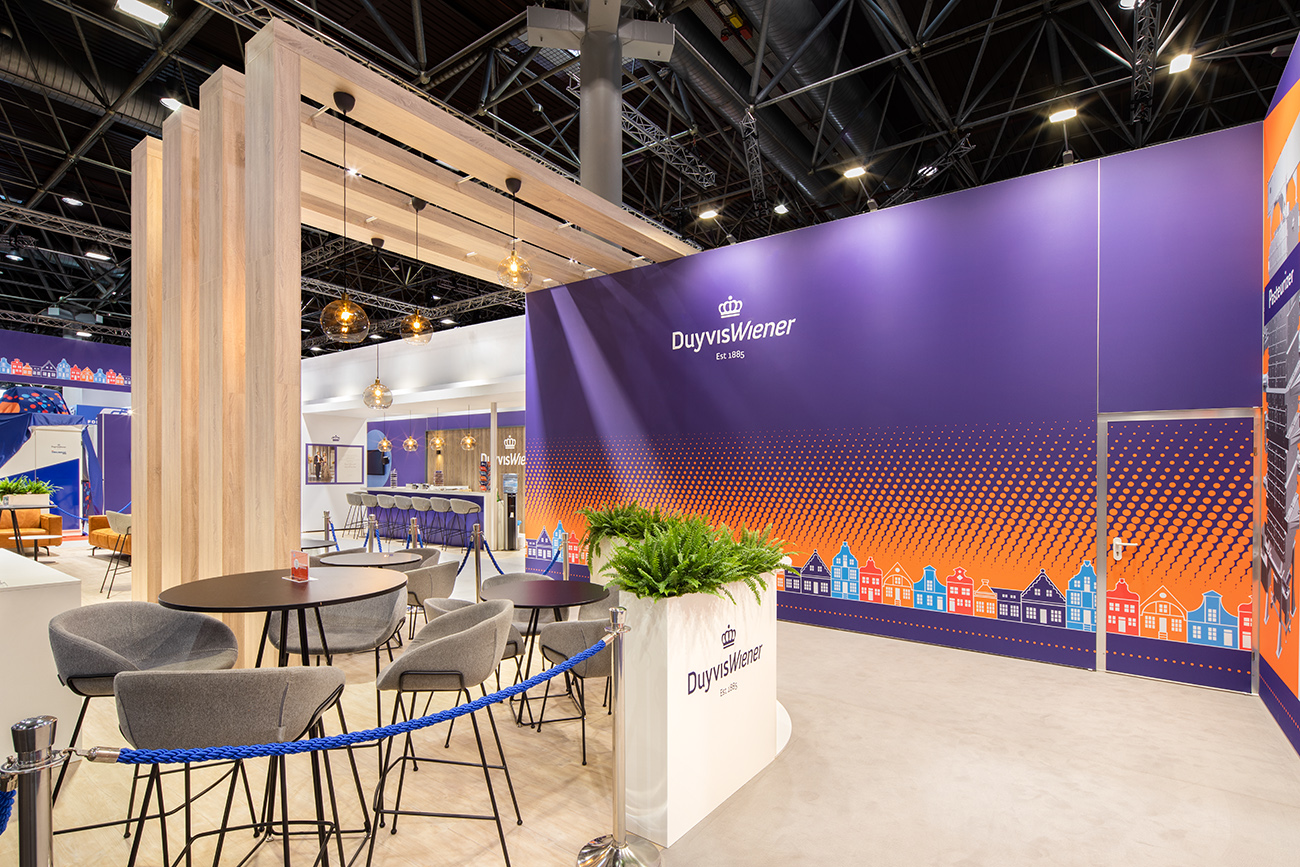
Two progressive companies, Boozed and Expoform, join forces in a special double interview. At first glance, what may seem to be an unlikely combination, the creative-conceptual experiences architects of Boozed and the Twente family business Expoform with its sober, thoughtful approach, turns out to be a very strong match.
Two B Corps on sustainability, employership and meaningful entrepreneurship
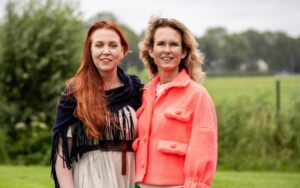
Kim de Ridder and Pauline Hilbrink share not only a passion for impactful and sustainable experiences, but also a shared vision of future-proof entrepreneurship. Their companies, Boozed and Expoform respectively, have been awarded the B Corp certificate for sustainable business.
Their first introduction followed from a tip that Pauline got from sub-contractor JMT Floorcoverings: You should have a coffee with Kim, that suits you. At the first cup of coffee their shared values were already proved, says Kim: "Despite having two very different companies, we think about a lot of things the same."
What makes you two bond like this?
Kim: "I think both Pauline and I have a lot of nerve. We dare to think differently. We both have a family culture company. A very important shift in society is that as an entrepreneur and employer you simply build a healthy and sustainable business and make money . Nowadays you don't need it from your neighbors, church or community center. At least in the west of the country, there is no social structure. So your role as an employer is becoming increasingly important."
Pauline: "We want someone to work with us for as long as possible, and you have to do a lot on both sides. We don't work from nine to five. Often changes occur at the last minute, or we work on weekends and holidays. We ask for a lot of flexibility from our staff, so we have to put a lot of opposites there. That makes my work more fun and makes their work more fun."
Kim: "We also believe that you have to be smart about what the world gives you, and deal with it as consciously as possible. I notice that it is not customary in our industry, and so much is wasted. A lot of companies are inclined to have a few new banners made for each party, while they have pilots full of that stuff. That always fascinates me."
Pauline: "That's why we both wanted to be B Corp. The route was much more intense than we thought beforehand, so it helped to spar on that."
Kim: "We now hope that by sharing our experiences, we can create a ripple effect in the industry. Because we still have a long way to go in the fairs and events industry towards sustainability."
About Expoform
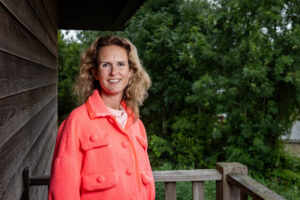
Six years old was Pauline Hilbrink when she first went to a scholarship with her parents. There she saw with her own eyes what beautiful things you can create in a short time, as long as you work together. Nine years ago she took over the family business together with her brother-in-law Gerwin from her parents and is at the helm of Expoform, where working together is still the main driver.
What can the industry do to make it more sustainable?
Kim: "Sustainable work requires a different way of thinking. That starts with the first customer interview. In doing so, you need to look wider than the initial demand of the customer. I always ask: Why are you doing anything? How are you gonna do it? Do you have any plans outside this scholarship we could use this material for again? At an event, a pop-up or in your own property . . There is already a lot to win."
"It also means looking critically at your planning, so that you don't get any stress from late delivered logos a week before the trade show, having to work nights to finish the artwork and constantly arrive at a printer with urgent jobs."
Pauline: "We sometimes get applications for build and burn. Then they want to put a stand together as cheap as possible on the spot and throw it away after the fair. We're not going to do that. It's terrible to see it still happening so much. Organizers should prohibit that."
"And you can. Last time I was at a fair in Italy where it was mandatory to have a modular system, and forbidden to barn and mold in the hall. The problem is that regulation in Europe is very fragmented. It would be nice to have the same laws and rules everywhere, if only based on fire safety."
What is the biggest challenge in this market?
Kim: "Many challenges in the stand building amount to transport, and there is still no real solution. Try driving an electric trailer to Paris or Barcelona. Well, good luck!"
"Paulin and I are doing everything we can to calculate correctly, to take efficiency where we can and possibly to combine transporters, but in the end you just want a car that drives as clean as possible. For this, the market must cooperate."
Is the market prepared to do so?
Pauline: "Finally, you only need one that changes and makes it a success. Then the rest of the competition will go. The more people ask for a sustainable product, the more companies will offer sustainable options. That's what we saw."
For 20 years we have the same vinyl tiles from Forbo. You can really use them endlessly and clean them up. They stay beautiful. The problem is, they're brown. That used to be hip, but now nobody wants a brown floor. So we turned them in after 20 years. Forbo completely recycles them to grains to turn them into new tiles. Beautiful company that is!"
Does B Corp help?
Kim: "The beautiful on B Corp is that it gives you new ideas. Not only in terms of sustainability, but also in terms of employership and the impact you have on society. You're actually taking the whole chain, because you're pushing your suppliers to move forward or just working with parties that want to."
Pauline: "It makes you think about things you never thought about. That is very often very inspiring, but also frustrating. My parents started the company with "farmer understanding," as they call it. And with noaberdom, a Twente concept that means taking care of your neighbors. If anyone asks for help, you help. This is a matter of course, and that is how the company has always been. That's probably in our DNA, just not on paper."
"It's a lot of work to formalize this for the B Corp certification, but if you've made it, then you've really made it! Very entrepreneurial The Netherlands screams that they are sustainable, even if it is only because they separate waste. This means you can no longer see the difference between a grey and a green event organisation. B Corp helps because you don't just get the certificate."
What advice would you give companies that want to make sustainable?
Kim: "I think it is especially important that companies think about what kind of employer they want to be. If you want to certify there are many ways to do that, for example from industry associations. And there are also many sustainability initiatives where you can join. But I think that such a label will eventually be distinctive. There are a lot of multinationals that have to comply with certain laws and regulations, and then it helps if your supplier is a B Corp."
"We already see this development. We won a pitch this year based on our B Corp status. Of course, the customer was enthusiastic about the concept we presented, but we were more expensive than the competition. Yet they chose us because of the label."
Pauline: "It helps not only to attract customers, but also to attract talent. I spoke to two other applicants recently who both asked, "What are you doing about sustainability and how important it is to you?" Well, those questions were never asked in the 20 years before."